
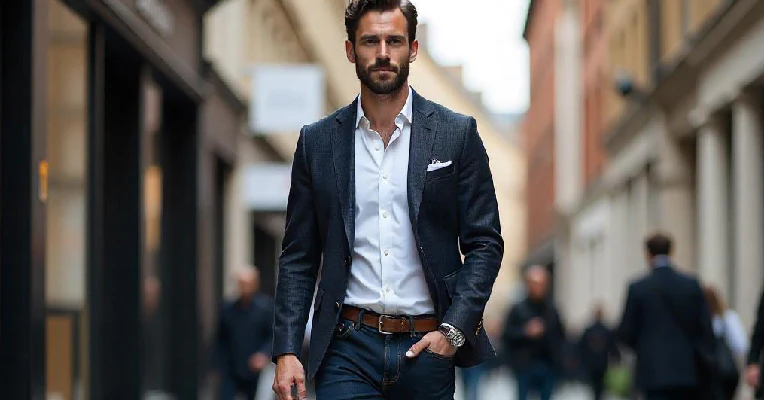
Over the past four years, I’ve helped professionals at companies such as the NY Times, Dropbox, and Google revamp their wardrobes.
The most common style challenge they all faced?
Understanding what to wear in a business casual work environment.
Even among other “experts,” there seems to be a lot of confusion about what business casual actually means these days.
Today, I want to tell you that you can relax.
Business casual doesn’t have to be confusing or challenging.
Today, I’m giving you the first practical guide to business casual style.
With a few guiding principles and a template for building your wardrobe, I’ll show you how to become the best-dressed man in the room.
In this guide, you’re going to learn:
Part 1: What exactly is business casual?
Step one: Throw everything you know about dress codes out the window.
Seventy-five years ago, you wouldn’t have left the house without a coat, tie, and hat.
Twenty years ago, you would never have worn chinos to the office.
And just last month, Wall Street stole a page from the playbook of tech companies that are poaching their best talent and relaxed their dress code (more or less).
The only thing that remains constant about dress codes is the fact that they are constantly changing. Who knows, maybe I’ll update this guide in a few years to reflect another change.
So you have my permission to throw your old business casual rules out the window. Let’s start fresh.
Did you do it?
Good.
Step 1: Figure out what business casual means at your job
The annoying thing is that business casual means different things in different industries.
If you’re like many of my clients in the tech industry, you can relax a lot more and enjoy more freedom in your wardrobe choices.
If you work in a field such as science or finance, you’re probably just a step away from wearing a full suit and tie.
Here are my tips for figuring out where your job falls on the formality scale:
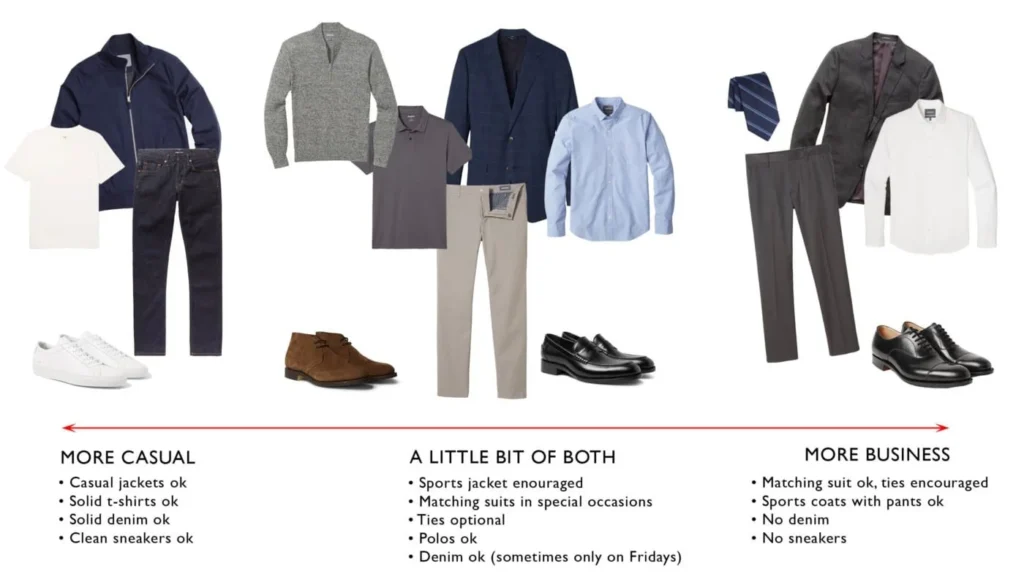
Tip #1: Look around at what people are wearing
Simple, but effective.
Perhaps you have one of those jobs where the bosses wear T-shirts and jeans and expect employees to wear ties (or vice versa).
So consider the style of your office as a whole, look around, and form an average.
Do most people wear sports jackets and shirts? Then your workplace is probably more business-oriented.
Are there a lot of men in jeans, boots, and sweaters? Then your workplace is probably more casual. Use the handy scale I’ve put together above as a starting point.
Tip #2: Ask HR (and your higher ups!)
If your company has a human resources department, they should be able to provide you with information about what clothing is appropriate in the workplace. So stop by or send an email.
I would also recommend talking to your supervisors about what you should wear. (Let them know that you are updating your wardrobe to better represent the company. They will appreciate it.)
I have found that it is even more helpful to ask them what is absolutely unacceptable and what is expected of you.
Step 2: Identify what items are casual and formal with this trick
“How am I supposed to know if something is too casual?”
You don’t have to study fashion for 15 years like I did to answer that question.
You just need to understand a few basic design principles to quickly assess whether a garment is more “casual” or “formal” (e.g., more businesslike).
There are a few general rules that we should all be familiar with.
We know that suit pants and shirts are more formal than T-shirts and jeans.
But what if we have to choose between two very similar garments, e.g., between a shirt and a button-down shirt?
We can assess the formality using the so-called “more means more casual” rule.
The MORE details a garment has, the MORE CASUAL it is.
More designs, more seams, more colors, more zippers mean more casualness.
Let’s take a closer look.

Rule #1: The more details an item has, the more casual it is
Think of a T-shirt with a print compared to a plain white T-shirt.
Or cargo pants with lots of pockets compared to simple, clean chinos. They may be made of the same fabric, but the many pockets, seams, and details make them more casual. You probably wouldn’t wear these pants to an important meeting.
This rule will become clearer later when I introduce you to the garments on the formality scale.
But for now, think about this rule differently: the simpler and more minimalist the design, the more formal the garment.
Rule #2: The more colorful, the more casual
A pink shirt is more casual than a crisp white shirt. A light blue suit is more casual than a dark navy suit.
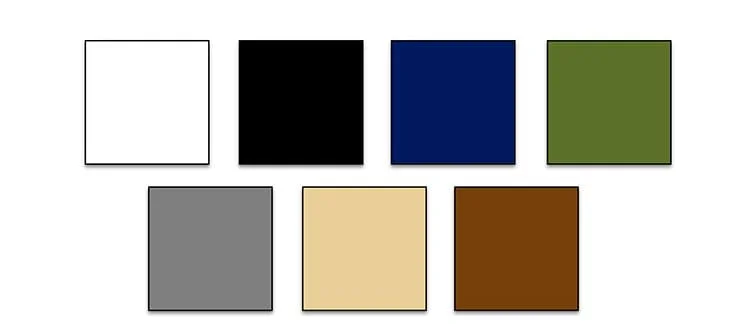
When it comes to formality, neutral colors (navy, white, black, grey, olive, camel), come off more professional and formal.
Rule #3 The trendier, the more casual
More trendy designs—such as athleisure sweatshirts, Hawaiian print shirts, or sling bags—can be classified as “casual.” Items that are higher on the formality scale tend to have a more classic, timeless design.
While this tool isn’t 100% reliable, it’s a good starting point to use when shopping and planning your outfits.
But don’t worry, in the next section, I’ll explain exactly how casual or formal something is so you can plan your wardrobe. You’ll see that just because something is more casual or more formal doesn’t mean you can’t incorporate it into your business casual wardrobe.
As with any good wardrobe, it’s not about a single piece of clothing, but how your garments work together as part of a versatile wardrobe.
Part 2: Build your perfect business casual wardrobe
So, you’ve figured out the direction you want to take your business casual wardrobe in.
You’ve learned how to quickly tell whether a garment is more casual or more formal.
Let’s use what we’ve learned to put together your perfect business casual wardrobe for starting your career.
The perfect business casual template
As I mentioned in my post on building a minimalist wardrobe, I like to start with outfits for 1.5 weeks.
Why?
Because most people do laundry about once a week. We want to have enough clothes for every day of the week, plus a few extra days just in case.
If you do laundry less often or want more variety, just add more items to this template. But I recommend everyone start with this.
Assuming you do laundry once a week, I recommend the following for building a minimalist wardrobe:
20 items of clothing (excluding socks and underwear)
- 1 coat
- 2 jackets (1 business, 1 casual)
- 10 tops
- 1 sweater
- 3 pairs of pants
- 10 pairs of underwear
- 10 pairs of socks
- 2 pairs of leather shoes
- 1 pair of sneakers
Here is a breakdown of the wardrobe:
We want multiple copies of items of clothing that we shouldn’t wear twice in a row.
You know, the things that quickly become uncomfortable, like shirts, underwear, and socks. One for each day, plus two or three more as spares.
Plan for our laziness.
In a perfect world, we would all do our laundry on schedule every 7 days. But some weeks I’m lazy, and I’m sure I’m not alone in that. That’s why, instead of clothes for 7 days (6 days + what you wear on laundry day), we stock up for 10 days as a “laziness buffer.”
Don’t count accessories
Accessories such as ties, bags, pocket squares, and sunglasses are purely optional, but they offer an easy way to add an exciting element to your outfit without taking up much space in your closet.
Let’s take a look at this wardrobe in action. This is what a week of business casual outfits could look like with just 20 pieces.
Build your custom wardrobe
To help you build a business casual wardrobe, I have categorized the styles I have used for my clients in the past according to their formality.
Just take a look at the tables below and choose what you like.
A few notes before you begin:
How these items were rated
I used several criteria to rate the formality of the following items.
First, I used the long-standing rules for formality in men’s clothing that we all know (a T-shirt is more casual than a dress shirt, a leather jacket is more casual than a blazer).
Then I made adjustments based on my experience over the past four years with men who work in industries with business casual dress codes. I didn’t evaluate every possible style, just the most common ones I’ve used to build my clients’ business casual wardrobes.
In certain professions, there are always exceptions when it comes to the appropriateness of certain items of clothing. That’s why I strongly recommend that you follow the steps in Part 1 and talk to HR about the dress code.
This wardrobe guide is suitable for all seasons.
I recommend planning your wardrobe using this guide and then making seasonal adjustments as needed using my spring/summer and fall/winter guides.
Start with neutral colors.
At the end of each article, you will find my recommendations for specific colors.
We stick to the rule of neutral colors because they are the most versatile. By definition, neutral colors do not clash with each other, so you can combine them endlessly. This means you don’t have to worry about combining colors. If you still need ideas, don’t worry, we will discuss outfit ideas in Part 4.
Once you have the minimum recommendations, feel free to expand
This is optional, but once you have the recommended minimum amount of neutral colors, feel free to add more styles and colors for variety.
What’s the difference between a button-up shirt and button-down shirt?
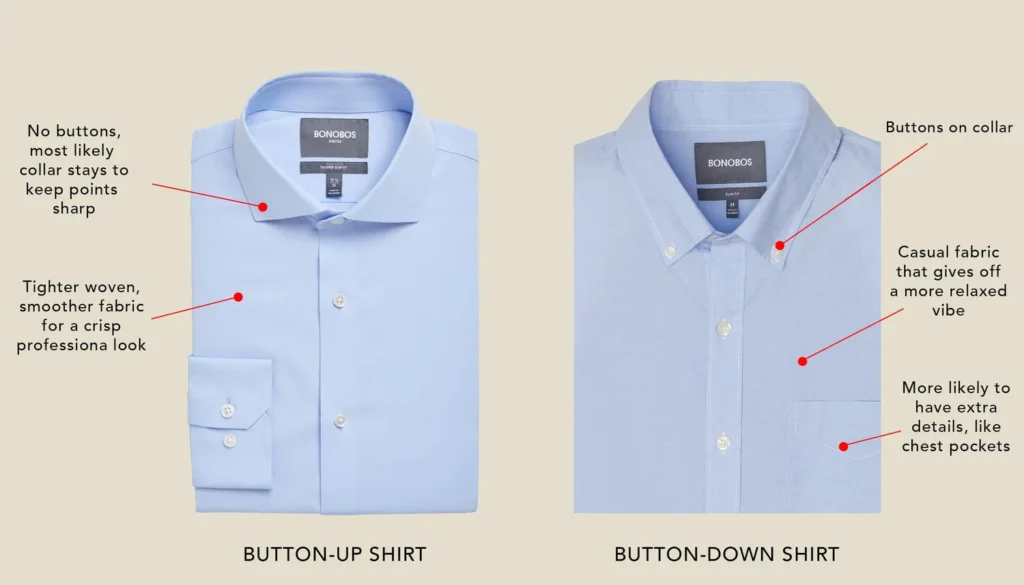
You may have seen shirts labeled “button-ups” and “button-downs” and not thought much of it, but these are actually two different types of shirts.
The term “button-down” describes the collar, which is fastened to the body with buttons.
Button-down shirts are generally considered a casual option today, are often cut shorter so they don’t need to be tucked into pants, and are made from more casual fabrics.
Button-ups are made from stiffer fabrics to ensure a professional look and are cut longer so they can be tucked into pants.
While you can wear button-downs with suits and button-ups with a Harrington jacket, for example, I generally recommend pairing button-ups with formal outfits such as suits and button-downs with casual outfits.
In short, a button-down shirt is more casual than a button-up shirt.
KNITS/SWEATERS
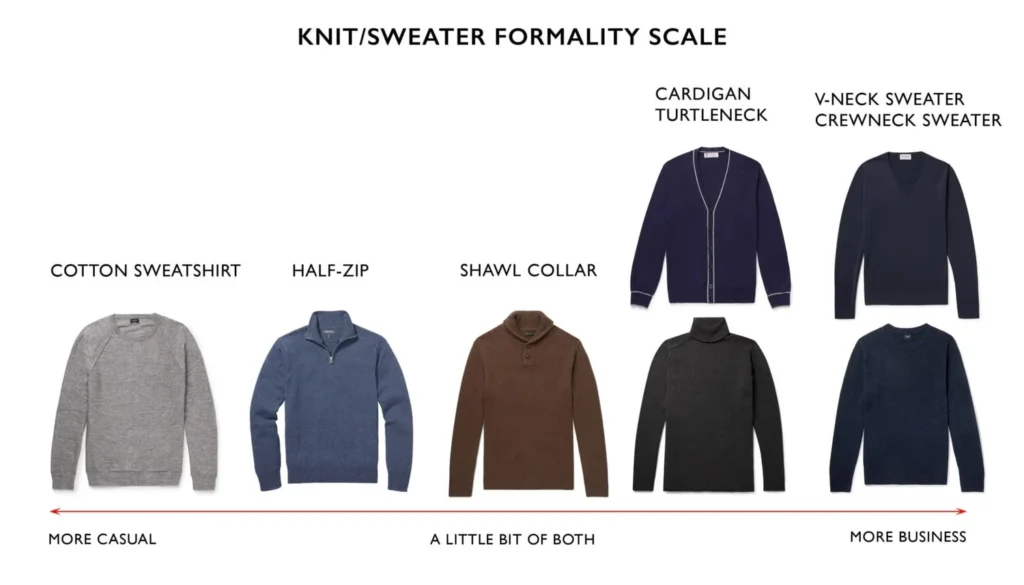
A fine merino wool sweater is ideal for throwing on during cooler days. Wear it over a shirt if you want to skip the jacket for a more elegant look. For a more casual wardrobe, cotton is the right choice. And if you’re looking for something more luxurious, cashmere is the top choice (and my personal recommendation!).
PANTS
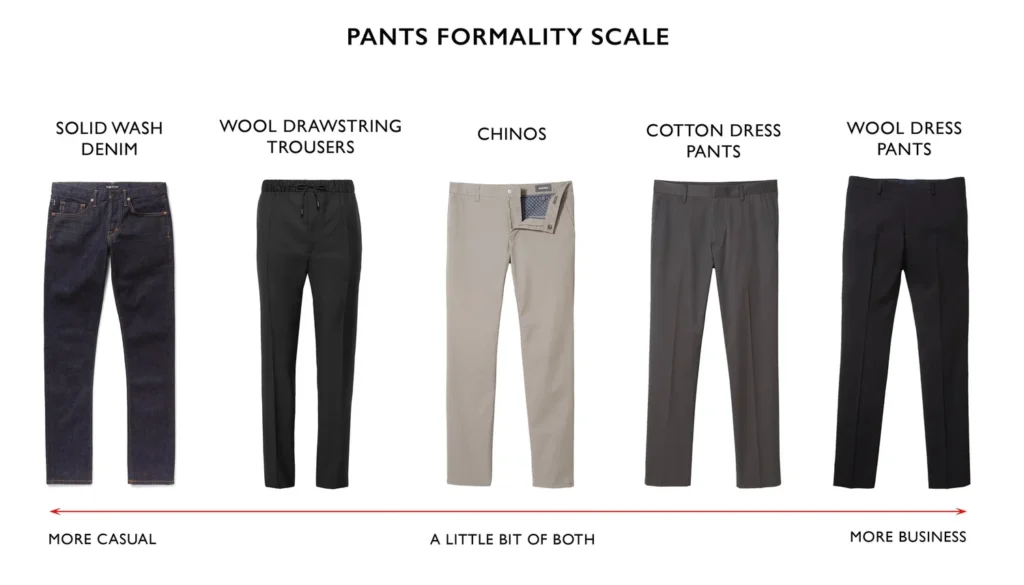
For a perfectly balanced business casual wardrobe, I would recommend one pair of casual pants such as jeans, one pair of tailored wool pants, and something in between, such as chinos. Of course, this depends on your job, as some of my previous clients were not allowed to wear jeans. In this case, you should stock up on chinos or wool pants.
Part 3: Putting it all together
How dressing better makes you more money
The biggest mistake my private clients make when working with me is that they want to look exactly like their colleagues.
Why is that a bad idea?
Because it’s my job to make you look damn good, and chances are your colleagues have a pretty average style.
Dressing well is one of the few career advantages that is often overlooked because it’s a little politically incorrect. But there are countless studies that show that you can earn more money with good clothing.
The easiest way to achieve this is to avoid some business casual clichés that I’ve observed over the years.
Business casual outfit idea formulas
So you’ve crafted your perfect business casual wardrobe and need some ideas on how to wear it.
No matter what level of business casual your job has, I got you covered with these 7 essential business casual outfit formulas.
THE CLASSIC
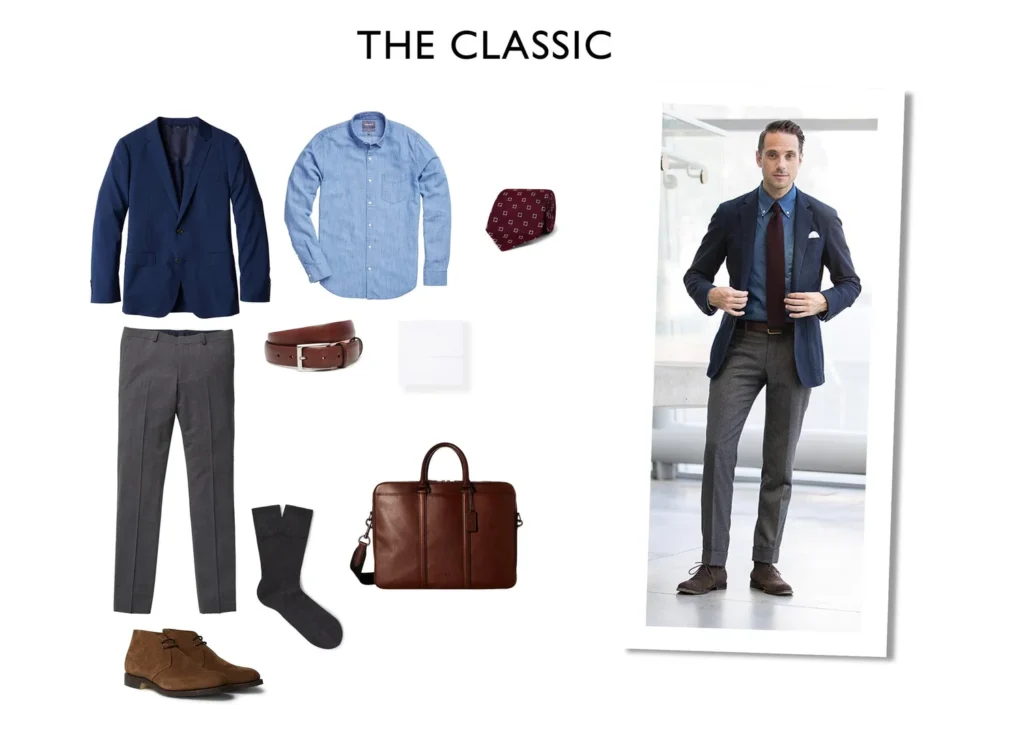
Sports jacket + shirt + chinos/suit pants + tie
If you had to sum up a classic business casual outfit, it would be this: sports jacket, mismatched pants, shirt, tie.
The inspirational image goes one step further and combines a button-down shirt instead of a button-down shirt (a very unconventional move, especially when paired with a tie). Lovers of classic men’s fashion may be outraged, but I wouldn’t worry too much about it. In the real world, this is perfectly acceptable.
I love the pop of color that the chambray shirt adds, but this look also works with a more traditional white or light blue top.
THE T-SHIRT
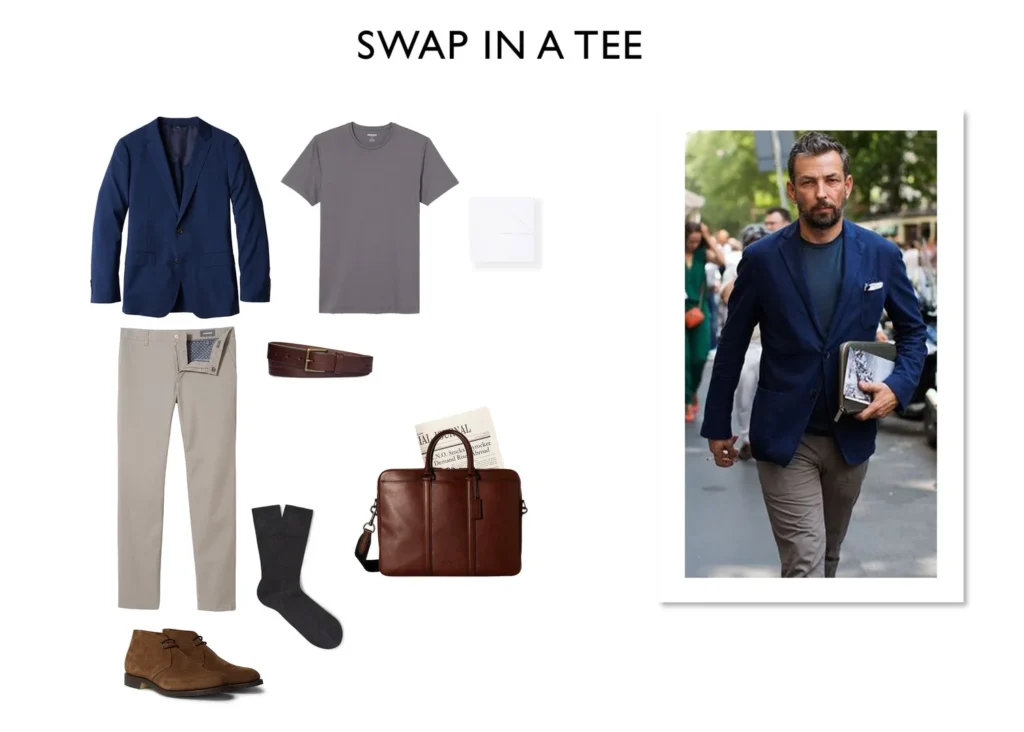
Sports jacket + T-shirt + chinos
You might want to save this combination for casual Fridays. The key to success when wearing a T-shirt under a sports jacket is not to overdo it with casual clothing. If you wear jeans or sneakers with it, you’re skating on thin ice. It’s best to stick to the business side of the spectrum, as I did with chinos and desert boots.
THE POLO
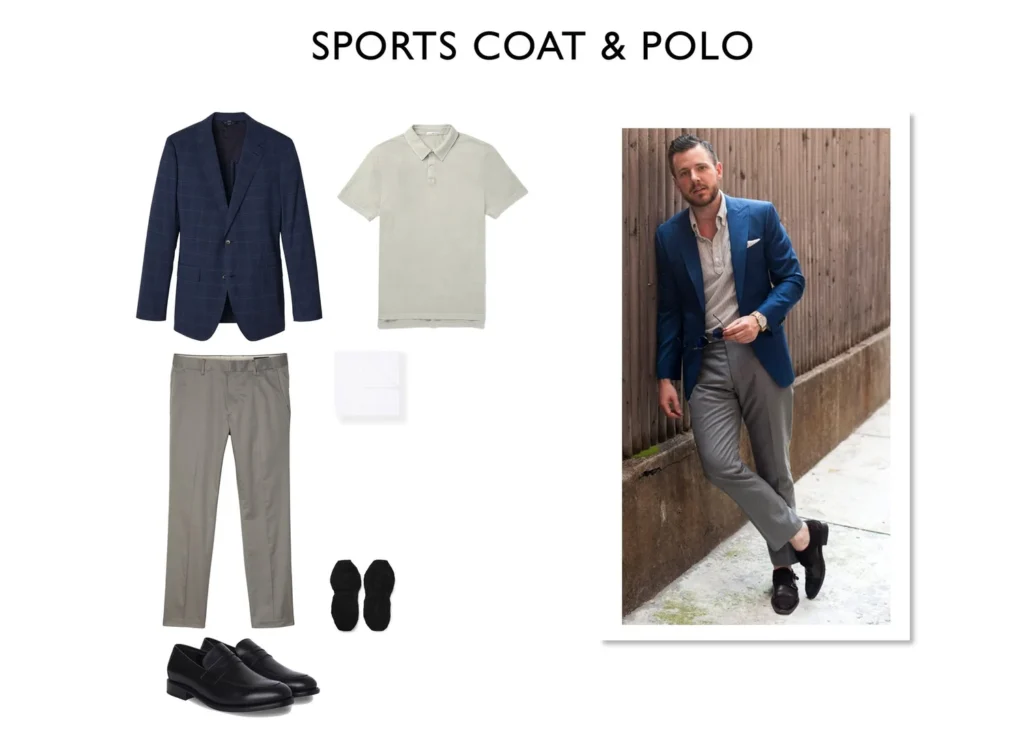
Sports jacket + polo shirt + suit pants
The more elegant big brother of the T-shirt look. Notice how the collar of the polo shirt elevates the look slightly while maintaining the casual feel of a T-shirt. If you decide to go sockless this season, be sure to wear invisible socks to avoid blisters.
THE NO JACKET LOOK
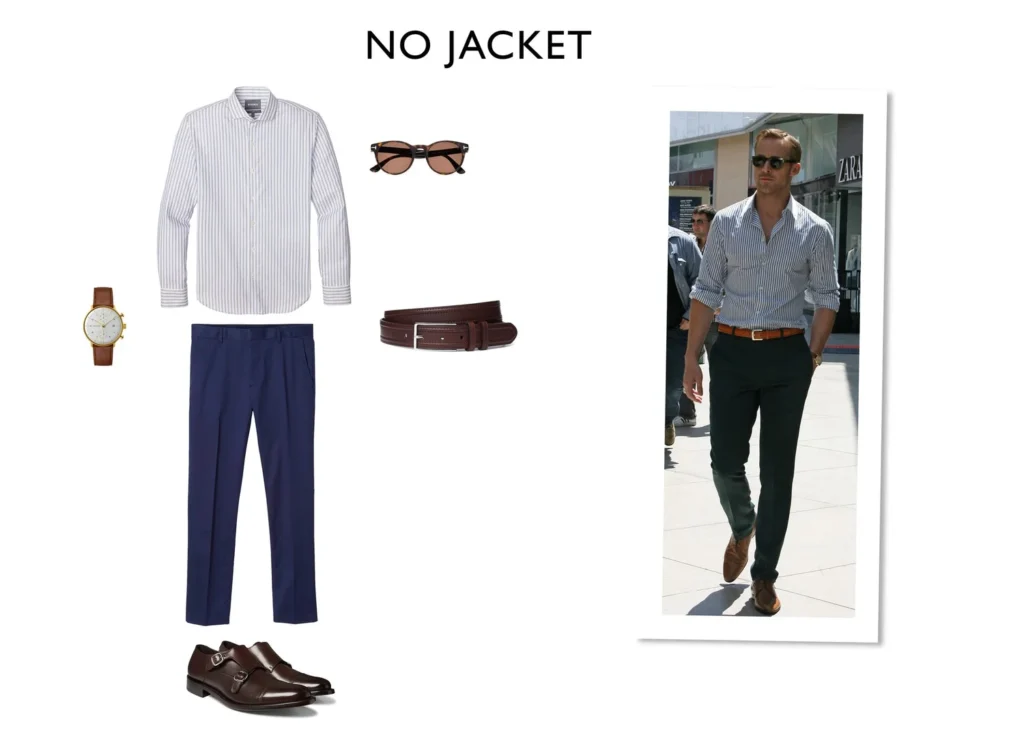
Button-down shirt + dress pants + belt + cool watch
Leave the fleece vest at the office. Pull off this simple style hack by rolling up your sleeves when you head out for lunch. The key to this look is in the accessories—a belt is a must, sunglasses are optional, but a nice watch is highly recommended.
